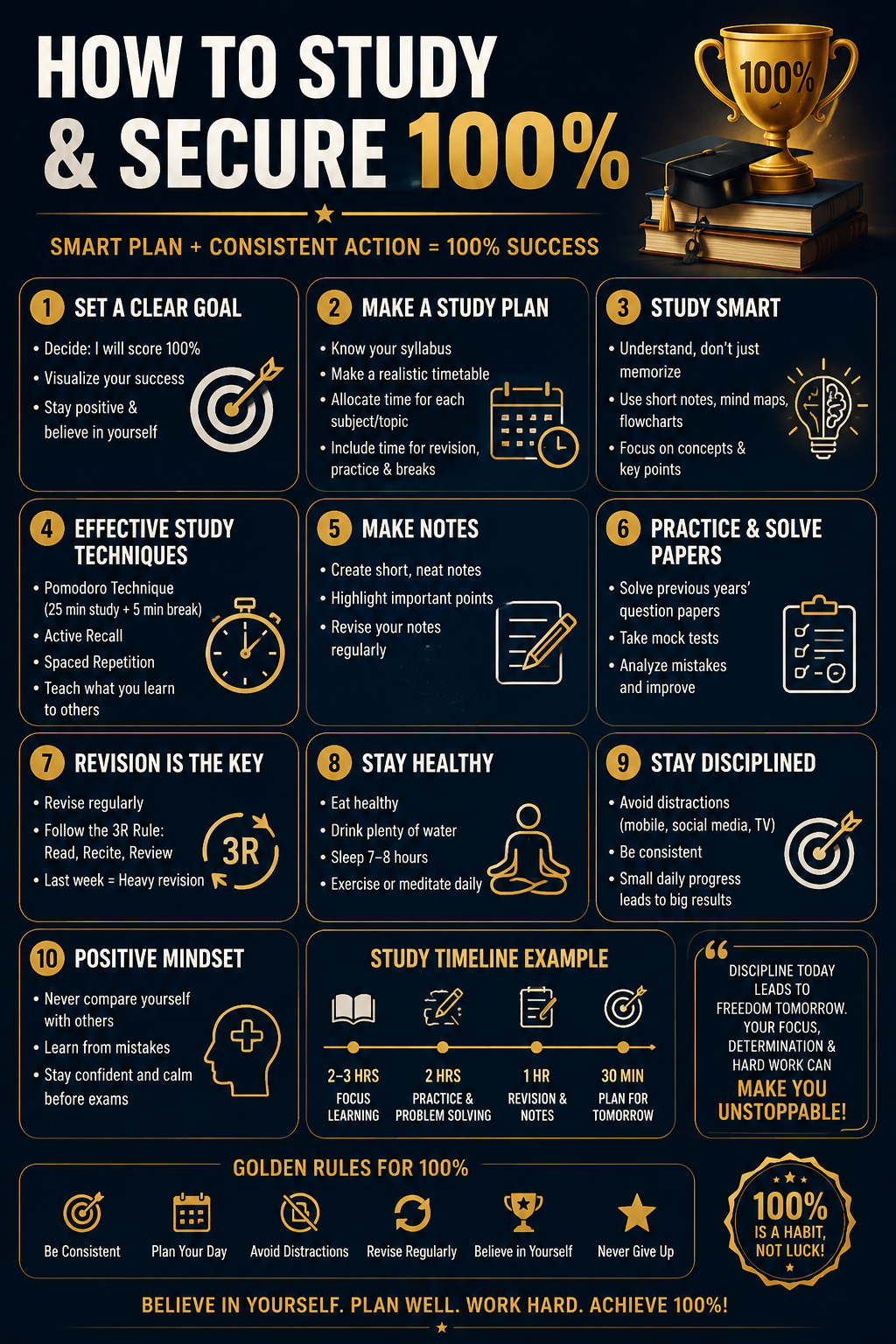
# How to Study and Secure 100%: A Practical Strategy for Students
# Change Your Habits - Learn new ways to study, keep a pencil ready.
Scoring 100% in an examination is not only about studying for long hours. It is about **studying with the right strategy, understanding concepts clearly, revising intelligently, and avoiding mistakes**.
Many students study for 8–10 hours but still struggle to score high. The reason is simple: **time spent studying is not the same as effective studying.**
If your goal is to achieve your maximum possible score, follow these practical steps.
## 1. Set a Clear Target
Before you begin studying, decide exactly what you want to achieve.
Instead of saying:
> “I will study Maths today.”
Say:
> “I will complete Chapter 5, solve all examples, practise 20 questions, and revise my mistakes.”
A specific target gives your mind direction.
## 2. Understand, Don't Just Memorise
The strongest students don't simply memorise answers. They understand **why** something is correct.
Ask yourself:
* What does this concept mean?
* Why does this formula work?
* How can I explain it in my own words?
* Where can this concept be applied?
Once you understand the concept, remembering it becomes much easier.
## 3. Follow the 3-Step Study Method
Use this simple cycle:
### Learn (Mark with Underlines and Make small notes) → Practise → Revise (Mark the Difficult Part)
**Learn:** Understand the concept from your textbook, teacher or reliable study material.
**Practise:** Solve questions without looking at the answer.
**Revise:** Return to the topic after a gap and test yourself.
This is much more effective than repeatedly reading the same chapter.
## 4. Make Your Own Short Notes
Don't try to copy your entire textbook into your notebook.
Create short revision notes containing:
* Important definitions
* Formulas
* Key points
* Important dates
* Diagrams
* Common mistakes
* Difficult questions
Your notes should help you revise an entire chapter quickly before an examination.
## 5. Practise Previous Questions (Use RTM Formula)
(Repeat, Test and Mark)
One of the best ways to prepare for an examination is to solve previous-year papers and sample papers.
Practising questions teaches you:
* How questions are asked
* Which topics are important
* How much time you need
* Where you make mistakes
* How to present your answers
Don't just check whether your answer is correct. **Analyse every mistake.**
## 6. Maintain a Mistake Notebook
This can become your secret weapon.
Whenever you make a mistake, write down:
**Question → Your Mistake → Correct Method → Lesson**
Before every examination, revise this notebook.
Your goal is not to avoid making mistakes while practising. Your goal is to **avoid repeating the same mistake in the examination.**
## 7. Use Active Recall
Close your book and ask yourself questions.
For example:
> “What are the three main points I studied in this chapter?”
Try answering without looking at your notes.
If you cannot remember something, go back, learn it again and test yourself.
This makes your revision much stronger than simply reading.
## 8. Follow Spaced Revision
Don't wait until the night before the examination to revise everything.
A simple revision pattern can be:
**Day 1:** Learn the topic
**Day 2:** Quick revision
**Day 4:** Test yourself
**Day 7:** Revise again
**Before Exam:** Final revision
Repeated revision at increasing intervals helps strengthen memory.
## 9. Protect Your Concentration
Put your phone away while studying.
Try a focused study session such as:
**50 minutes study + 10 minutes break**
During those 50 minutes, focus only on the planned task.
Avoid constantly switching between WhatsApp, Instagram, YouTube and your books.
**Deep concentration for one hour can be more valuable than several distracted hours.**
## 10. Take Care of Your Body
Your brain needs energy to learn.
Don't sacrifice sleep just to increase study hours.
Maintain:
* Proper sleep
* Regular meals
* Enough water
* Some physical activity
* Short breaks during long study sessions
A tired brain cannot perform at its best.
## 11. Practise Writing Under Exam Conditions
Knowing the answer and writing the answer correctly in an examination are two different skills.
Take a sample paper and set a timer.
Sit without your phone or notes and complete the paper within the required time.
Afterward, check:
* Accuracy
* Speed
* Presentation
* Spelling
* Calculations
* Unattempted questions
This will help you become comfortable with examination pressure.
## 12. Have a Final 7-Day Strategy
During the final week, don't try to learn everything from scratch.
Focus on:
**Day 7–5:** Important chapters and weak topics
**Day 4–3:** Practice papers and difficult questions
**Day 2:** Formulas, definitions and short notes
**Day 1:** Light revision and mistake notebook
Avoid studying completely new and difficult topics late at night before the examination.
## 13. The 100% Mindset
Remember one important thing:
**You cannot control every question that appears in an examination. But you can control your preparation.**
Don't study with fear.
Study with a system.
Don't ask:
> “How many hours should I study?”
Ask:
> “What should I accomplish during this study session?”
Don't compare your preparation with someone else's.
**Compete with your previous performance.**
## Final Thought
Scoring 100% should be treated as a **goal, not a guarantee**. The real objective is to prepare so thoroughly that you can confidently attempt every question you know and minimise avoidable mistakes.
The formula is simple:
**Clear Goal + Understanding + Practice + Revision + Mock Tests + Mistake Analysis + Discipline = Maximum Performance**
Start today.
Don't wait for the perfect timetable.
**Pick one chapter. Put your phone away. Set a timer. Start studying.**
Your next improvement begins with the next focused study session.
← Back to Blogs
2026.08.20
How to Study?