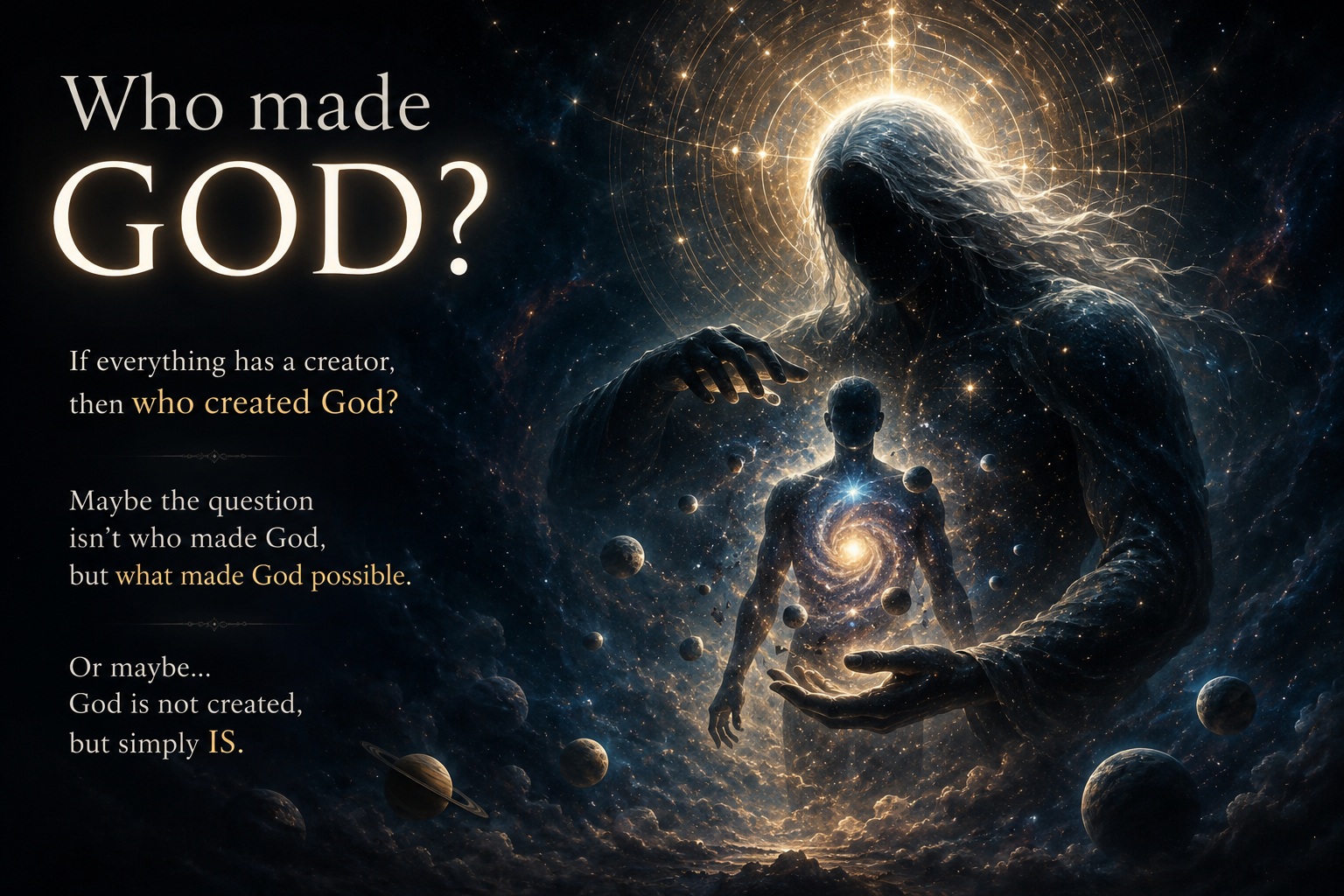
From the earliest stages of human thought, people have wondered about the mystery of existence: **Who are we, why are we here, and what is the nature of the Creator?** Throughout history, sages and spiritual teachers have explored these questions. In India, this search for truth gave rise to the tradition of *satsanga*—the company of the wise and spiritually awakened. Through such association, a sincere seeker (*sadhak*) receives inspiration and gradually deepens his understanding of the Divine.
One question, however, seems almost unavoidable: **If God created everything, who created God?**
According to the spiritual philosophy of the *Bhagavad Gita*, God is not another being within creation who came into existence at a particular moment. He is the Infinite Reality from which creation itself emerges.
In **Bhagavad Gita 4:6**, Krishna declares in essence:
> **“Though I am unborn and My nature is changeless, I become manifest through My own divine power while remaining the Lord of creation.”**
This suggests that the Divine does not become God through some external cause. Rather, creation emerges through the mysterious power known as *maya*, through which the One appears as the many.
We may imagine the Infinite as an immeasurable ocean. When creation manifests, waves arise upon that ocean. The waves may appear separate, but their substance is never different from the ocean. Similarly, the universe—with its energy, matter, life and consciousness—can be understood as manifestations arising from the Infinite.
The ancient **Rig Veda 10.129**, known as the *Nasadiya Sukta* or Hymn of Creation, approaches the origin of existence with remarkable humility. Rather than offering a simplistic explanation, it reflects on the profound mystery of how creation began and whether anyone can ultimately know its origin.
This humility is important. The human mind operates within the universe and understands things largely through **cause and effect**. We therefore tend to assume that everything, including God, must have a cause. But if God is truly Infinite, He cannot be subject to the same limitation that governs finite creation.
As **Bhagavad Gita 9:4** teaches:
> **“In My unmanifested form I pervade the entire universe. All beings exist in Me, yet I am not confined by them.”**
The Divine therefore may be present within creation without being limited by creation. The law of causation belongs to the manifested universe; the Infinite is beyond that law.
Creation has a cause—but the Infinite simply **is**.
The *Bhagavad Gita* expresses this beautifully in **7:7**:
> **“There is nothing higher than Me. All things are held in Me, as pearls are strung upon a thread.”**
So, who made God?
From this perspective, **nobody made God**. If something created God, then that creator would itself require a cause, producing an endless chain of creators. The very meaning of the Infinite is that it has no beginning, no end and no external cause.
Perhaps this truth cannot be fully understood by intellectual reasoning alone. Spiritual realization offers another way of knowing. When consciousness turns inward and experiences its unity with the Divine, the seeker may discover that the individual self is like a wave in an eternal ocean of Cosmic Consciousness.
The wave has a beginning and an end.
**The ocean is.**
And so, the deepest spiritual answer to **“Who Made God?”** may be: **God was never made. The Infinite exists—beginningless, endless, and causeless.**
← Back to Blogs
2026.02.01
Who Made God?